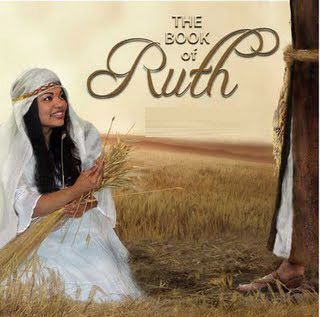
Bitterness and Faith – Ruth 1:14-22
14 Again they wept loudly, and Orpah kissed her mother-in-law, but Ruth clung to her. 15 Naomi said, “Look, your sister-in-law has gone back to her people and to her god. Follow your sister-in-law.” 16 But Ruth replied: Do not persuade me to leave you or go back and not follow you. For wherever you go, I will go, and wherever you live, I will live; your people will be my people, and your God will be my God. 17 Where you die, I will die, and there I will be buried. May Yahweh punish me, and do so severely, if anything but death separates you and me. 18 When Naomi saw that Ruth was determined to go with her, she stopped trying to persuade her. 19 The two of them traveled until they came to Bethlehem. When they entered Bethlehem, the whole town was excited about their arrival and the local women exclaimed, “Can this be Naomi?” 20 “Don’t call me Naomi. Call me Mara,” she answered, “for the Almighty has made me very bitter. 21 I went away full, but the Lord has brought me back empty. Why do you call me Naomi, since the Lord has pronounced judgment on me, and the Almighty has afflicted me?” 22 So Naomi came back from the land of Moab with her daughter-in-law Ruth the Moabitess. They arrived in Bethlehem at the beginning of the barley harvest. (HCSB)
The passages covered in this third lesson on Ruth contains two main parts. The first is the continuing exchange between Naomi and Ruth, and the second is their return to Bethlehem. Let’s take a closer look at the two sections.
Verses 14-18
14 Again they wept loudly, and Orpah kissed her mother-in-law, but Ruth clung to her. 15 Naomi said, “Look, your sister-in-law has gone back to her people and to her god. Follow your sister-in-law.” 16 But Ruth replied: Do not persuade me to leave you or go back and not follow you. For wherever you go, I will go, and wherever you live, I will live; your people will be my people, and your God will be my God. 17 Where you die, I will die, and there I will be buried. May Yahweh punish me, and do so severely, if anything but death separates you and me. 18 When Naomi saw that Ruth was determined to go with her, she stopped trying to persuade her.
As verse 14
As it begins, it leads the reader to believe that Naomi has been successful in persuading both of her daughters-in-law to return to Moab. Instead, it is a division point. Orpah listens to Naomi’s advice believing it is in her best interests to return to Moab. However, Ruth refuses to leave Naomi’s side.
The two women, Ruth and Orpah, who began the narrative as equals, are now distinguished as distinctively different. Orpah makes the logical choice for her future and exits the story. We never know if Naomi’s prayers for her were answered. It is interesting that Orpah is not criticized for her actions or as a figure of unbelief. The focus now shifts to Naomi and Ruth. In contrast, Ruth now shines as a beacon of fortitude and faith that comes out in this final decision point discussion between Naomi and Ruth.
Verse 15
Naomi makes one final plea, using Orpah as an example of the best decision for Ruth to make. However, Naomi has no support for her position outside of Orpah’s decision to return to Moab.
It should also be noted that Naomi tells Ruth to go back to her gods. It is easy to overlook this simple statement as Moab didn’t worship Yahweh; they worshipped several “gods,” with Chemosh being the predominant one. The statement identifies two problems/facts. First, in general, the deteriorated state of Israel’s understanding and commitment to Yahweh. Second, that Naomi would actually address idols as gods.
One final point to consider is that since all the men had died, Ruth was technically under the guardianship of Naomi and culturally should have been obedient to her wishes. In Ruth’s decision to follow Naomi, we see God’s sovereign grace to save Ruth and bring her into the family of Yahweh.
Verses 16-17
These two verses are amazing, considering the cultural differences between the two women and the seriousness of the commitment that Ruth was making to Naomi. Ruth’s narrative in these two verses breaks down into five two-line couplets. There is an introductory command to Ruth, followed by three couplets ending with a challenge to the witness to the statement.
- Do not persuade me to leave you or go back and not follow you.
- For wherever you go, I will go and wherever you live, I will live.
- Your people will be my people , and your God will be my God.
- Where you die, I will die, and there I will be buried.
- May Yahweh punish me, and do so severely, if anything but death separates us.
The second and fourth couplets represent a pair of opposites, life and death, bracketed by Ruth’s declaration that she will commit herself to not only Naomi but to Yahweh. The third couplet is the most amazing. Ruth is turning her back on everything that had been familiar to her and is now willing to place her entire trust and faith not only in Ruth and the Jewish people but on a grander scale she is ready to place her trust in Yahweh.
The oath that Ruth swears is in the name of Yahweh, Israel’s God, who Ruth now accepts as her own. The form that it takes is in the typical pattern of a Jewish oath where a curse is declared against the maker of the oath if they fail to fulfill the pledge.
Verse 18
When Naomi saw that Ruth was determined to go with her, she stopped trying to persuade her.
The forcefulness and oath at the conclusion of Ruth’s speech leave Naomi no other choice than to let Ruth stay with her.
Verses 19-21
19 The two of them traveled until they came to Bethlehem. When they entered Bethlehem, the whole town was excited about their arrival and the local women exclaimed, “Can this be Naomi?” 20 “Don’t call me Naomi. Call me Mara,” she answered, “for the Almighty has made me very bitter. 21 I went away full, but the Lord has brought me back empty. Why do you call me Naomi, since the Lord has pronounced judgment on me, and the Almighty has afflicted me?”
The first point to note is that two women traveling alone over a relatively long distance made it to Bethlehem without anything happening to them along the way is an indication of Yahweh’s protection.
The second point is the contrast between the excitement at their arrival and the questions they ask themselves.
- The excitement at Naomi’s return.
- She had been gone for more than ten years.
- Her family had heard of the grief she experienced.
- The likely shock that a Moabite woman accompanied Naomi.
- They question, “Can this be Naomi?”
- There can be little doubt the years and grief had taken their toll on Naomi.
- Her appearance was likely nowhere near what it was when she left.
- Naomi, “the pleasant one,” was now a haggard and destitute woman.
- Their reaction is not lost on Naomi.
- Her bitterness reappears, and she asks for a new name.
- Mara would be understood in Hebrew to mean “to be bitter.”
- The depth of her bitterness comes out in verses 20b-21.
- Naomi lays four accusations against God following an A B B A pattern, Shadday (Almighty), Yahweh (LORD), Yahweh, Shadday.
- There is also a play on words and the accusations Naomi places against God.
- She left as Naomi, the pleasant one, in a state of fullness.
- She returns as Mara, to be bitter, in a state of emptiness.
The third point is also a contrast – the actions and behavior of Naomi and those of Ruth.
- Naomi, one of God’s chosen people of the nation of Israel, does nothing but complain bitterly and blames God for her misfortune.
- Ruth, the Moabite and a bitter enemy of Israel displays restraint and decorum in her actions.
- The one who grew up in a nation of idol worshippers, Moab, displays more faith and a humble spirit than the one who allegedly knew the living God.
Verse 22
So Naomi came back from the land of Moab with her daughter-in-law Ruth the Moabitess. They arrived in Bethlehem at the beginning of the barley harvest.
The last verse of chapter one neatly summarizes what has occurred and sets the stage for what is to transpire next. As the book continues, the prominence of Naomi will decline, while the prominence of Ruth will rise. Considering the cultural barriers at work, this is amazing for three reasons.
- Ruth is from Moab and could expect little acceptance from the residents of Bethlehem.
- She is Naomi’s daughter-in-law, having no status of her own.
- They just returned. They are the “new kids on the block,” even though Naomi had lived there previously.
However, the part of verse 22 is “at the beginning of the barley harvest.” This is a signal that their fortune was about to change.
- The meaning of Bethlehem is “the house of bread.”
- The barley harvest was the first harvest of the agricultural season, typically occurring in March-April.
- This was followed by the wheat harvest in May.
- The two women were returning to a period of plentiful food.
- The timing of their return signals that Yahweh is about to prove His covenant faithfulness to these women.
- Through food to eat.
- Through a covenant redeemer, Boaz.
Applications
- Chapter 1 of Ruth describes a journey, heartbreaking in places. We need to recognize and remember that even when the bitter times in our lives leave us feeling empty, God uses them to shape us, mold us, and if we’ve wandered from Him, to call us back.
- Even though there are times we can’t control circumstances, we can control how we react to them. Meditate on 1 Thessalonians 5:18 Give thanks in everything, for this is God’s will for you in Christ Jesus.
- The Scottish preacher George H. Morrison said, “Nine-tenths of our unhappiness is selfishness, and is an insult cast in the face of God.” If we are selfish in our grief, bitter, we direct our anger at God instead of trusting God and resting in His peace.
- Just as Naomi had hit rock bottom, she returned to Bethlehem at a time of plenty to start over again. God is always waiting for us to return to Him if we’ve wandered away, to enjoy a life of plenty and refreshment in His presence.
- The faith that Ruth displayed in her decision to return with Naomi is one of the greatest in the entire Bible. Is our faith like that of Ruth’s or like that of Orpah?
 Diggin' in the Word